
Everything You Need to Know

Rooftop Solar in Odisha: Your Questions Answered

Clear, honest answers about costs, government subsidies, system types, installation, and everything in between. If your question is not here, our team is a call away.

Costs and savings Subsidies up to Rs 1,38,000 System types explained Panels and warranties
How much does a rooftop solar system cost?
The final price depends on system size, the quality of panels and inverter you choose, and the condition of your roof. Because every home and business is different, we give you an exact written quote only after a free site visit and load assessment. This way you know precisely what you are paying for, with no hidden costs.
How much will I save on my electricity bill?
Savings depend on how many units you consume, the size of the system installed, and your local tariff slab. A correctly sized solar system can offset a large share of your monthly consumption, and in many cases can bring your grid bill down close to the minimum fixed charge. We calculate a personalised savings projection as part of your free design and quote.
What is the payback period?
Most residential systems pay for themselves through electricity bill savings over a period of a few years, especially once you account for the combined central and Odisha state subsidy. After that, your panels continue generating nearly free electricity for the remainder of their 25-year-plus lifespan.
Are loan or EMI options available?
We can guide you toward financing routes suited to your system size and budget. Ask our team during your free consultation and we will walk you through the options available to you.
Is there a government subsidy available?
Yes. Under the PM Surya Ghar: Muft Bijli Yojana, the Government of India offers a central subsidy of up to Rs 78,000 for systems up to 3 kW. The Government of Odisha adds a state top-up of up to Rs 60,000, bringing your combined subsidy to as much as Rs 1,38,000 for a 3 kW system.
What does the subsidy look like for smaller systems?
For a 1 kW system, the combined subsidy is Rs 55,000 (Rs 30,000 central plus Rs 25,000 state). For a 2 kW system, it is Rs 1,10,000 (Rs 60,000 central plus Rs 50,000 state). For 3 kW and above, the combined subsidy reaches Rs 1,38,000 (Rs 78,000 central plus Rs 60,000 state). We confirm current figures against the latest official notifications at the time of your quote.
Who handles the paperwork and net metering?
Net metering is processed through TPCODL, the local distribution company, under state regulations, and OREDA coordinates renewable energy programmes across Odisha. We guide you through registration and approvals so you are not left navigating the process alone.
Do I need permission from my housing society or landlord?
If you own an independent house, you generally do not need separate permission. If you live in an apartment or a rented home, written permission from your housing society or landlord is usually required before installation.
1 kW System
Rs 55,000
Rs 30,000 central
+ Rs 25,000 state
2 kW System
Rs 1,10,000
Rs 60,000 central
+ Rs 50,000 state
What is the difference between on-grid, off-grid, and hybrid systems?
An on-grid system connects directly to the utility grid and does not need a battery, which keeps costs lower. An off-grid system runs completely independently using batteries, with no grid connection at all. A hybrid system combines grid connection with battery backup, giving you the best of both.
Will I have power during a grid outage?
A standard on-grid system shuts down automatically during a power outage, for the safety of utility workers repairing the line. If uninterrupted power during outages matters to you, a hybrid system with battery backup is the right choice.
What happens to the extra power I generate?
Under net metering, any surplus power you generate is sent to the grid and adjusted against your consumption, as per TPCODL's rules. This means you are credited for power you do not use yourself.
Do I need a battery?
Not for a standard on-grid system. A battery is only necessary if you want backup power during outages or if you live in an area with frequent or unreliable grid supply.
Does solar work on cloudy or rainy days, or on a shaded roof?
Yes, though output is lower than on a clear sunny day. Over a full year, a well-designed system still delivers the generation it was sized for. Shade reduces output more significantly, which is why we assess your roof carefully during the free site visit, and sloped roofs can usually still be fitted with the right mounting structure.
Option 01

On-Grid

  • Connected directly to the utility grid
  • No battery required, lowest upfront cost
  • Shuts down automatically during grid outages
  • Surplus power credited via TPCODL net metering
  • Best choice for areas with reliable grid supply
Most Popular
Option 02

Hybrid

  • Grid connection plus battery backup
  • Keeps essential loads running during outages
  • Higher upfront cost than on-grid
  • Surplus power still credited via net metering
  • Best for areas with frequent power cuts
Recommended for Outages
Option 03

Off-Grid

  • Fully independent, no utility connection
  • Larger battery bank required
  • Higher cost, designed for remote locations
  • No net metering - all power used on-site
  • Best for locations without grid access
For Remote Sites
How long do panels last, and what warranty applies?
Quality solar panels typically last 25 years or more, continuing to generate power well beyond their payback period. Panels generally carry a long-term manufacturer performance warranty, and inverters carry their own separate warranty period. We confirm the exact warranty terms for your chosen equipment when we provide your written quote.
Which panels and inverters do you use?
We select panels and inverters based on efficiency, build quality, and proven performance in Odisha's heat and humidity. We are happy to walk you through the specific brands and models we recommend for your roof during your free consultation.
How often do panels need cleaning?
Rinsing the panels with water every few weeks is usually enough to keep output high, more frequently if you are in a dusty area or near a construction site. Beyond that, panels need very little ongoing maintenance.
Will installation damage or leak through my roof?
Our trained technicians use proper mounting structures and sealing methods designed to protect your roof from leaks and damage, whether it is a flat RCC roof or a sloped sheet roof.
How long does installation take?
Physical installation usually takes just a few days once the design is finalised. Approvals and net metering registration with TPCODL can add further time, which we track and manage on your behalf.
What does after-sales service include?
Our support covers performance monitoring, scheduled maintenance visits, and warranty service coordination, so your system keeps running at its best for years after installation.
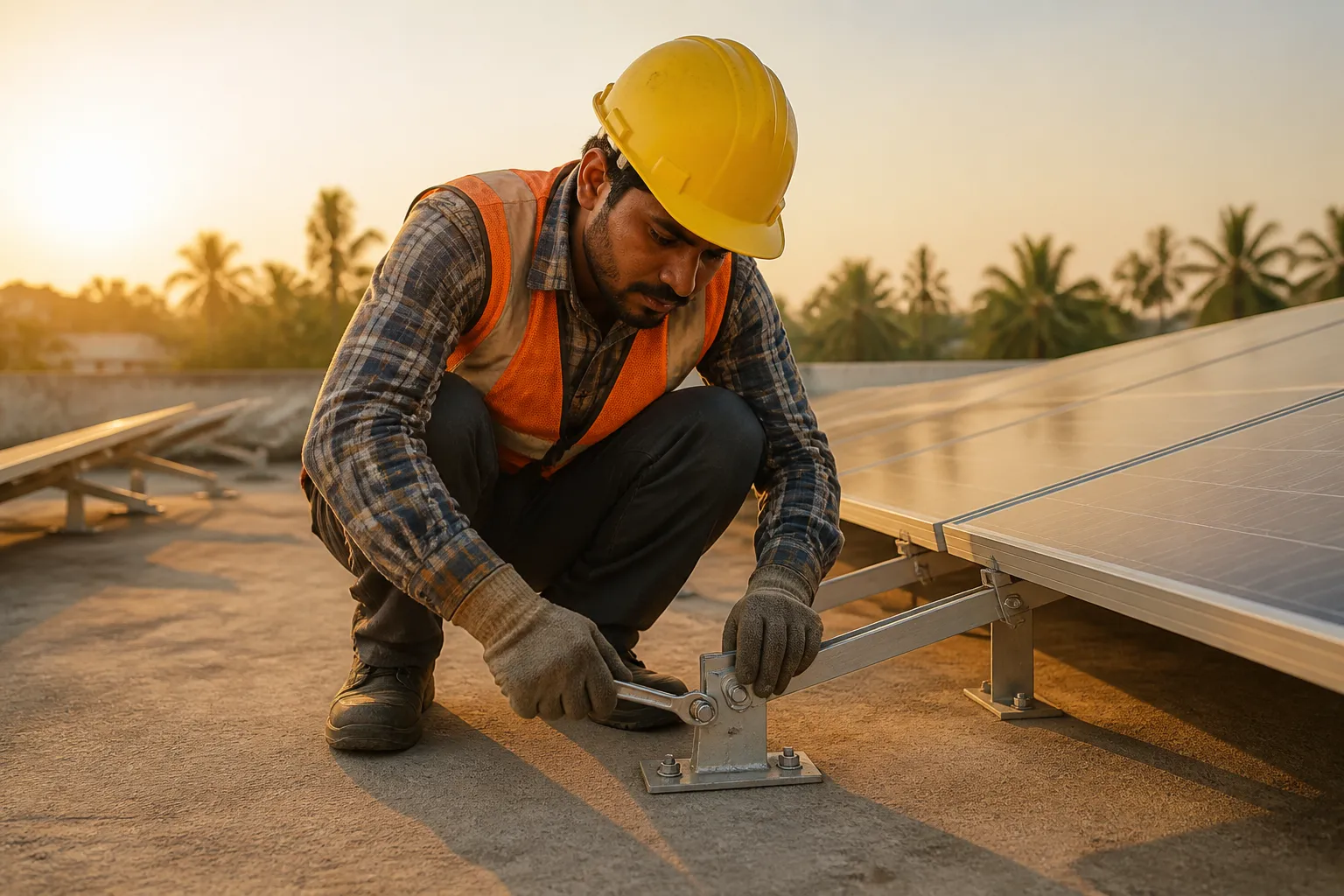
Arkasolar technician installing solar panel mounting brackets on a flat rooftop in Odisha
Roof Safety First

Installation that protects your roof

Our technicians are trained in proper mounting and sealing techniques for both flat RCC and sloped sheet roofs common across Puri, Khurdha and Cuttack. Every bracket is sealed to prevent water ingress and stress on your roof structure.

Book My Free Consultation
Still Have Questions?

Book a Free Site Visit and Get Clear Answers

Every roof, roof area, and electricity bill is different, and the best way to get clear answers is a free consultation and site visit with our team. We will assess your roof, estimate your subsidy, and give you a straightforward written quote - no pressure, no obligation.

Arkasolar is based in Kharvela Nagar, Bhubaneswar, and serves homeowners and businesses across Puri, Khurdha, and Cuttack district.

Free site visit and roof assessment
Clear written quote with subsidy calculated upfront
No obligation to proceed

Ready to Get Started?

Visit our contact page to book your free site visit. Our team covers Puri, Khurdha and Cuttack and will come to you at a time that suits you.

Plot No. A29/1, Kharvela Nagar, Bhubaneswar, Odisha. Serving Puri, Khurdha and Cuttack district.